The Menstrual Cycle as a Clinical Tool
A practical framework for understanding and supporting women’s occupational capacity in practice.
A self-paced CPD course for women Occupational Therapists, bringing menstrual cycle awareness into personal understanding, clinical reasoning and everyday practice.
3 hours of professional development · 49 lessons · 12 months of access
Start here: a little about the course
A rhythm worth understanding. A lens worth bringing into practice.
As OT's we’re trained to understand what shapes participation in everyday life — including routines, habits and the environments we move within.
But women’s lives are also shaped by a longer, cyclical rhythm — one that influences energy, cognition, motivation, and emotional experience across the month.
This rhythm is foundational.
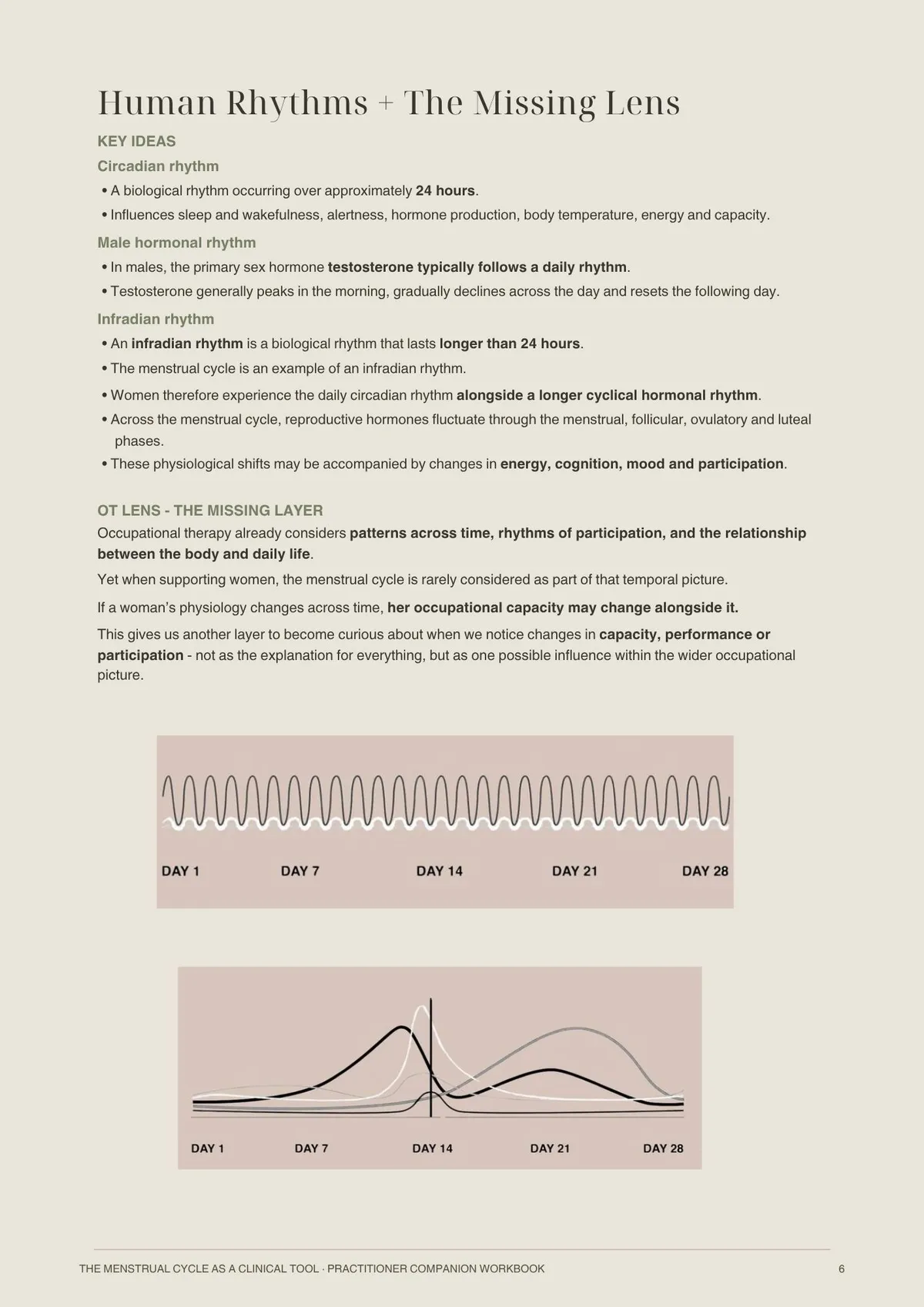
And yet, many of us received little education in menstrual health. We were not taught to understand the uniqueness (and gifts) of female biology, or how hormonal patterns, circadian and infradian rhythms shape the way we relate to ourselves, our capacity, and our participation in daily life.
You may have noticed these shifts in yourself or in the women you support — times when familiar routines feel manageable, and others when the same demands feel much harder.
When we view capacity through a linear lens and expect it to remain consistent, these patterns can go unrecognised and unexplored in our clinical conversations.
This course introduces a different way of seeing — a practical cyclical lens to help you ask more thoughtful questions, recognise individual patterns and respond to the woman in front of you.
From understanding the cycle to applying it in practice.
This self-paced CPD course offers a practical framework for understanding the menstrual cycle as an occupational rhythm — one that can shape capacity, routines and participation in everyday life.
Bringing together biology, lived experience and occupational therapy, it guides you from recognising cyclical patterns to exploring what they mean and how to respond.
Through personal reflection, nuanced cycle tracking and practical application, you’ll explore ways to support everyday life that are responsive to each woman’s changing needs — while deepening your understanding of your own rhythms.
A foundation for personal understanding, thoughtful clinical reasoning and practical support.
This course is for you if…
You support women or adolescents and want to bring menstrual cycle awareness into your practice.
You’ve noticed changes in capacity across the month and want a framework for exploring them.
You want practical ways to bring time and rhythm into assessment, goal setting and intervention.
You’re curious about your own cycle and how personal inquiry can enrich professional learning.
You value an approach that holds individual experience, context and choice at its centre.
You might work in women’s health, mental health, disability, adolescent care, paediatrics or community practice.
You’re an OT student curious about women’s health and how a cyclical lens can inform your future practice.
The Learning Journey
1. Recognise
Recognise the missing lens in how we understand women — both in practice and in ourselves.
Begin to see how hormonal patterns, circadian and infradian rhythms, and cultural expectations shape women’s lives and capacity.
This is an opening into a way of seeing that is rarely taught within occupational therapy.
2. Understand
Develop a deeper understanding of the menstrual cycle as an occupational rhythm.
Explore the four distinct phases, often understood as inner seasons, and how they influence energy, cognition, and participation — while recognising that these patterns are not rigid, but uniquely expressed in each individual.
3. Reflect
Use this understanding to explore your own lived experience.
Consider your menstrual story and current perceptions, and begin to notice your own unique patterns, responses, and needs across the cycle.
This includes developing a more nuanced and personal approach to tracking and relating to your cycle over time.
4. Reframe
Begin to see occupational participation through a cyclical lens.
Explore how changes in capacity can shape the way occupations are experienced across time — including their demands, meaning, ease and effort.
Reframe occupational balance away from consistency and towards a more dynamic understanding of participation, where capacity, context and what matters to the woman are considered together.
5. Apply
Translate cyclical awareness into practice.
Work through case examples and a clear clinical framework for identifying patterns, exploring occupational impact, setting meaningful goals, and collaboratively developing supports.
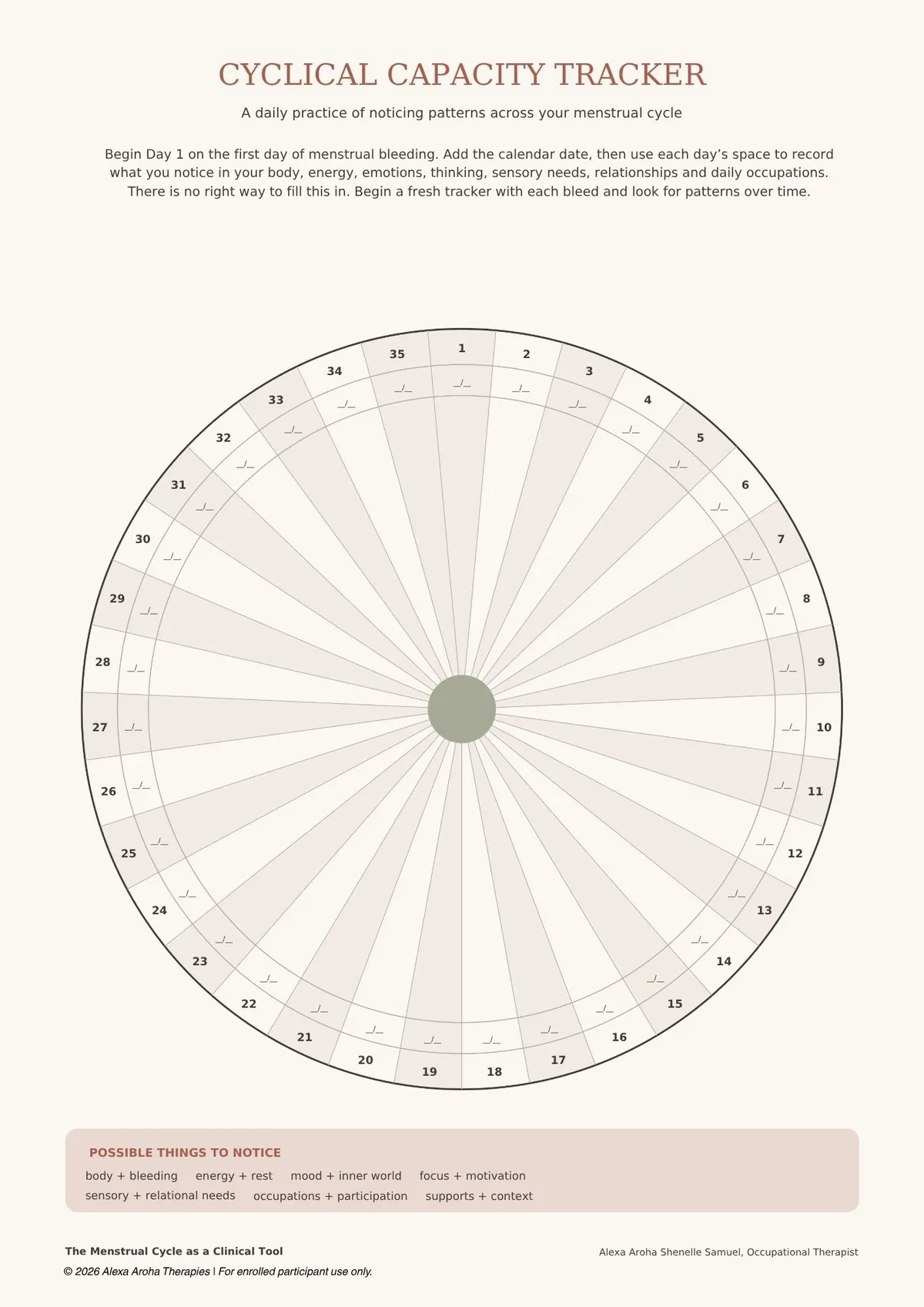
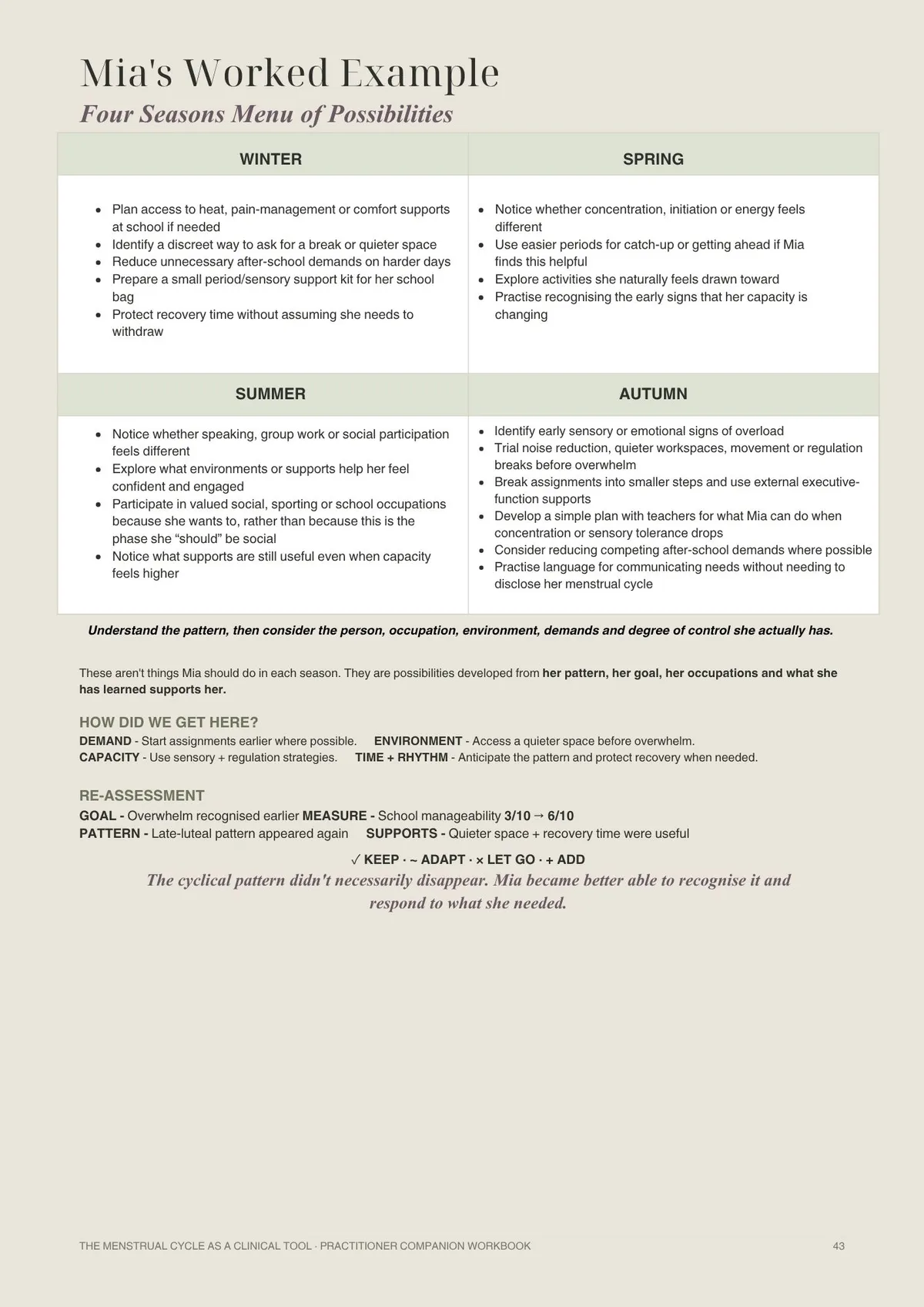
Learn to use the Cyclical Capacity Tracker and Four Seasons Menu of Possibilities to move from awareness into action — trialling, tracking, reassessing and refining supports according to each woman’s lived experience.
6. Integrate
Bring the learning together and recognise the menstrual cycle as one rhythm within the wider landscape of women’s lives.
Widen the lens to consider longer rhythms, life transitions, identity, culture and different ways women experience and relate to the world.
Explore what this opens within OT practice — expanding how we understand, ask questions and support women across changing capacities and seasons of life.
Course inclusions
3 hours of self-paced video professional development across 49 lessons
12 months of course access — learn at your own pace and revisit the material as your practice develops
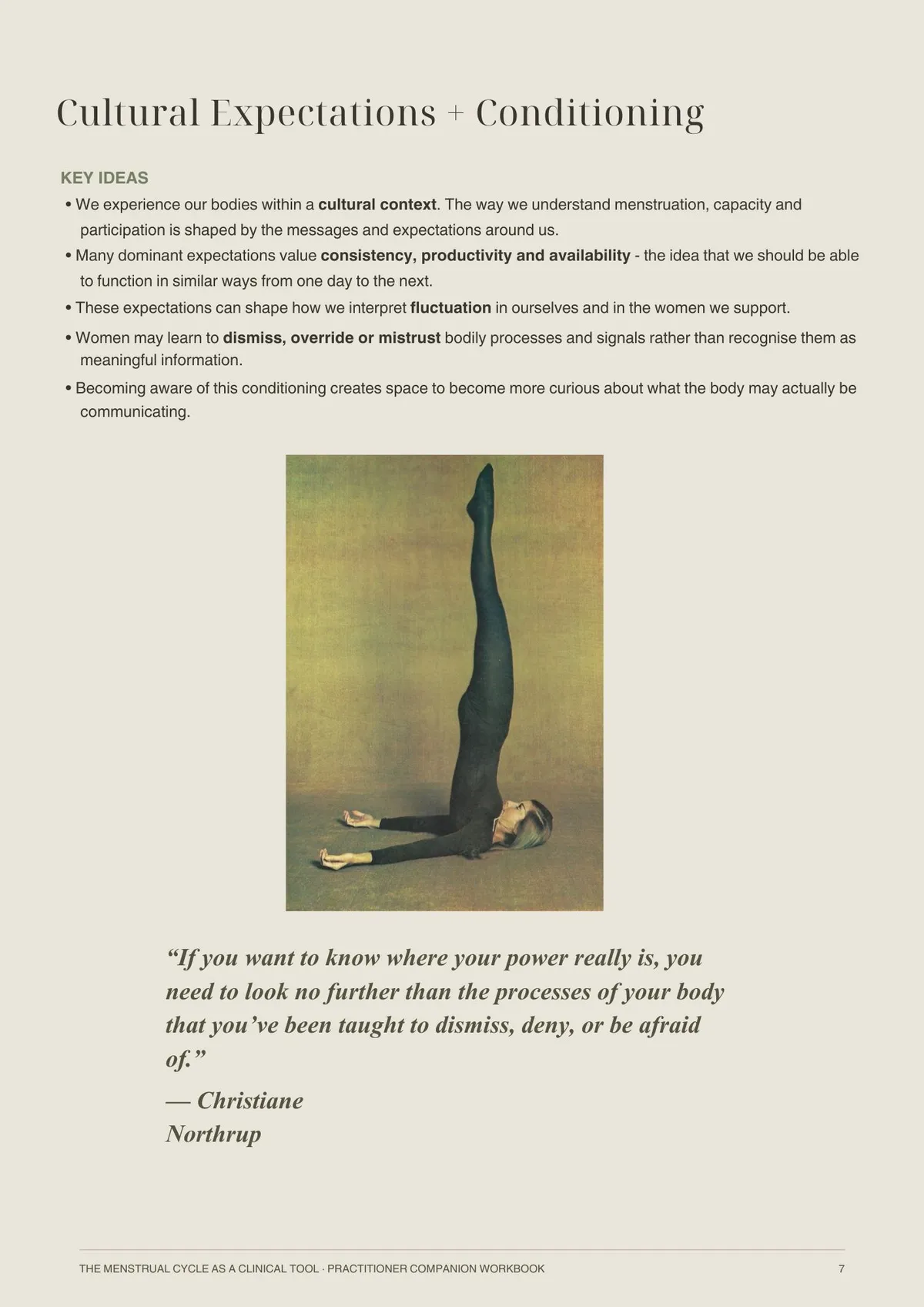
Practitioner Companion Workbook — revisits key learning from each lesson, with space for reflection and application to practice
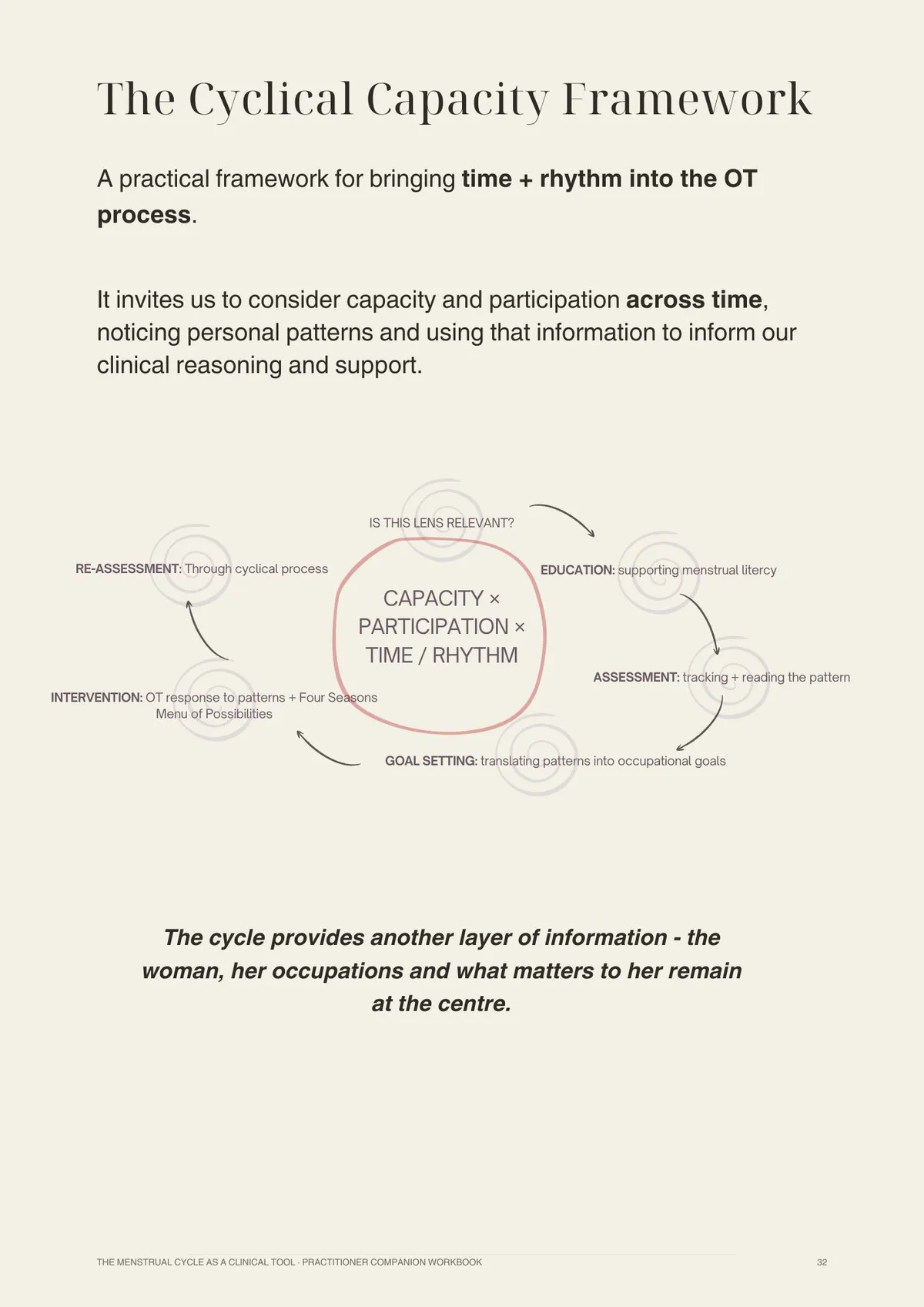
The Cyclical Capacity Framework — a practical framework for bringing time and rhythm into assessment, goal setting, intervention and reassessment
Guided reflective practices — supporting personal inquiry and embodied understanding
Circular Cycle Tracker — a printable tool for observing cyclical patterns over time
Four Seasons Menu of Possibilities: Practitioner + Client Editions — a cyclical intervention tool for applying cyclical wisdom to everyday activities, routines and support in response to changing capacity
Case-based learning — demonstrating application across the occupational therapy process
Clinical reasoning prompts — supporting assessment, pattern recognition and intervention planning
Integration quizzes + Certificate of Completion — consolidate key learning and document your 3 hours of professional development
A glimpse inside...
By the end of this course you will have
More than an understanding of the menstrual cycle.
A new lens for understanding your own body and the women you support — one that makes space for rhythm, changing capacity and the cyclical nature of women’s lives.
A practical framework and tools for translating this understanding into meaningful OT assessment, goals, individualised supports and reassessment.
An invitation to relate differently — to your own body, to changing capacity, and to the women you support — while bringing that understanding meaningfully into occupational therapy practice.
Learning Outcomes
Explain how circadian and infradian rhythms can shape women’s occupational capacity and participation.
Describe the four phases of the menstrual cycle and their physiological changes.
Identify how cyclical physiological changes may influence occupational performance, participation and capacity.
Analyse cyclical patterns through observation, reflection and cycle tracking.
Apply the Cyclical Capacity Framework across assessment, goal setting, intervention and reassessment.
Your investment
Founding price: $299 AUD or 3 monthly payments of $100 AUD ($300 total).
Enrol before 1 December 2026 to save $150 on the full-payment price and secure 12 months of access to the course and all included resources.
From 1 December 2026, pricing increases to $449 AUD or 3 monthly payments of $150 AUD ($450 total).
$449 AUD from 1 December
Yours today for $299 AUD
Two Payment Options
Founding price: Pay in full — $299 AUD
One payment with immediate access to the full course and resources for 12 months.
Price increases to $449 AUD on 1 December 2026.
Founding price: 3 monthly payments of $100 AUD
First payment today, followed by two monthly payments of $100 AUD. Includes immediate access for 12 months. Total: $300 AUD.
Price increases to 3 monthly payments of $150 AUD ($450 AUD total) on 1 December 2026.
Enrol before 1 December 2026 to secure founding pricing. Your remaining instalments will stay at $100 AUD each.
Frequently Asked Questions
Is the course live or self-paced?
The course is pre-recorded and self-paced, so you can work through the lessons in a way that fits your life.
How long does it take?
The video content totals approximately three hours across 49 lessons. Allow additional time if you’d like to engage more deeply with the workbook, reflective practices and tools.
How long will I have access?
You’ll have access for 12 months, giving you time to revisit the material as you begin applying it.
Do I need previous menstrual health knowledge?
No specialist menstrual health knowledge is required. The course begins with foundational understanding and builds towards practical application.
Is this relevant if I don’t work specifically in women’s health?
Yes. Women and girls who experience a menstrual cycle are part of many practice settings — from mental health and disability to paediatrics, adolescent care and community OT.
Whatever brings someone to occupational therapy, understanding their cyclical patterns can help them recognise changing needs and explore support for everyday life.
In paediatrics, this lens can also help you support girls approaching menarche — their first bleed and an important rite of passage — alongside parents navigating that transition. It offers a foundation for conversations about body awareness, changing routines and practical menstrual support.
You don’t need to specialise in women’s health to begin. This course gives you a practical framework to bring cyclical awareness into your work — and your own life, too.
How does this learning relate to my practice?
This course helps you bring cyclical capacity into the work you already do.
You’ll learn to explore patterns during assessment, consider changing needs when setting goals, and use practical tools to adapt routines and interventions collaboratively through a cyclical approach.
This can support more sustainable change by helping women develop strategies that accommodate changing capacity and fit their everyday lives.
This course provides a practical way to expand your clinical reasoning and support individualised, adaptable approaches to participation.
Does the course assume everyone experiences the same cycle?
No. I teach the cycle as a map to explore, with each woman’s lived experience guiding the way.
We begin with biology and the inner seasons, then deepen that understanding through observation, reflection and tracking. You’ll learn to recognise how a woman’s cycle interacts with her circumstances, occupations and changing needs — and use that understanding to shape individualised support.
The intention is to build trust in her own experience, rather than teach her what she should feel.
Will I leave with tools I can use in practice?
Yes. You’ll receive the Cyclical Capacity Framework, Circular Cycle Tracker and Four Seasons Menu of Possibilities in practitioner and client editions.
I’ve created these specifically through an occupational therapy lens — connecting cyclical awareness with everyday occupations, routines, capacity and participation.
The case study walk through also shows how to integrate them into assessment, goal setting, intervention and reassessment, so you can adapt the learning to your caseload and each woman’s needs.
Can I fit this around work and life?
The course is divided into 49 lessons, with approximately three hours of video learning. You can move through it gradually, pause for reflection and return to particular lessons when they become relevant to your practice.
With 12 months of access, there’s space to learn, apply and revisit.
Will I receive a certificate?
Yes. Once you complete the course requirements, you’ll receive a Certificate of Completion documenting three hours of professional development.
I’m an Australian-based occupational therapist. If you practise outside Australia, please check your local regulatory body’s requirements to confirm how this learning can count towards your CPD.
Bring a cyclical lens into your practice
Develop your understanding. Explore your own rhythms. Learn practical ways to recognise and respond to changing capacity in yourself, and the women you support.